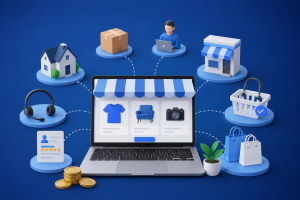
Choosing how to build an online store sounds straightforward until you start planning what the business actually needs. Shopify gives you a ready-made ecommerce ecosystem. You can create a store, add products, choose a theme, connect apps and start selling without developing the underlying ecommerce infrastructure yourself.
A custom ecommerce website takes a different approach. Instead of fitting your business into an existing platform, the store can be developed around your products, workflows, customers and integrations. Neither approach is automatically better.
A small retailer launching a straightforward catalogue may have completely different requirements from a manufacturer accepting bulk enquiries, a wholesaler with customer-specific processes, or an established ecommerce company integrating multiple internal systems.
So the real question isn’t:
Is Shopify better than custom ecommerce?
It’s:
Which approach fits the way your business needs to sell?
Let’s compare them.
What Is Shopify?
Shopify is a hosted ecommerce platform that provides much of the infrastructure required to operate an online store. Businesses can use it to manage products, inventory, orders, payments and other ecommerce functions without developing a commerce platform from scratch.
Shopify currently offers multiple subscription plans, while additional costs can arise from apps, themes, payment processing and other services depending on how a store is configured. Shopify publishes its current plan details and features on its official pricing page.
For many businesses, this convenience is precisely the attraction. Instead of building the underlying ecommerce system, you configure an existing one. That can make Shopify particularly useful when the requirements are relatively standard.
What Is a Custom Ecommerce Website?
A custom ecommerce website is developed around specific business requirements rather than relying entirely on the functionality and structure of a hosted ecommerce platform. That could mean something relatively simple, such as a custom-designed storefront.
Or it could involve much deeper functionality, including:
- specialised product configurations;
- custom checkout processes;
- B2B ordering;
- bulk order requests;
- customer-specific workflows;
- ERP or CRM integrations;
- supplier integrations;
- custom pricing logic;
- seller dashboards;
- subscription systems;
- internal administration tools; and
- bespoke reporting.
The distinction is important.
Custom ecommerce isn’t valuable simply because it is custom.
It becomes valuable when your business has requirements that standard platforms cannot accommodate efficiently. BwLogics’ online store development services cover Shopify, WooCommerce and custom ecommerce development, allowing the technology to be selected according to the actual store requirements rather than forcing every ecommerce project onto the same platform.
Shopify vs Custom Ecommerce Website: Quick Comparison
| Factor | Shopify | Custom Ecommerce |
|---|---|---|
| Initial setup | Usually faster | Usually requires more development |
| Upfront investment | Typically lower | Typically higher |
| Recurring platform fees | Yes | Depends on architecture/hosting |
| Customisation | Strong within platform ecosystem | Can be built around specific requirements |
| Hosting | Managed by Shopify | Selected and managed separately |
| Maintenance | Core platform maintained by Shopify | Requires ongoing technical maintenance |
| Integrations | Large app ecosystem | Custom integrations possible |
| Complex workflows | May require apps/custom development | Can be designed into the system |
| Platform dependency | Shopify ecosystem | Depends on chosen architecture |
| Best fit | Standard ecommerce requirements | Complex or differentiated business requirements |
This table gives you the overview.The decision becomes clearer when we look at what these differences mean in practice.
1. Speed to Launch
Shopify has a clear advantage when speed is the main priority. Because much of the infrastructure already exists, a business does not need developers to build fundamental ecommerce functionality such as product management, cart functionality and standard checkout from the ground up.
Choose a theme, configure the store, upload the catalogue, connect the required systems and prepare for launch. Obviously, a sophisticated Shopify project can still require significant development work, but the underlying foundation is already there. A custom ecommerce application takes longer because requirements need to be planned, designed, developed and tested.
Shopify may make more sense when:
You need a relatively conventional online store and want to get to market quickly.
Custom development may make more sense when:
The workflow itself is part of your competitive advantage and building it correctly matters more than launching with generic functionality.
2. Upfront Cost vs Long-Term Cost
Shopify generally lowers the barrier to entry because businesses can subscribe rather than fund the development of an entire ecommerce system. That doesn’t mean Shopify has one fixed cost. Businesses need to consider the selected plan, transaction/payment costs where applicable, premium themes, apps and development work.
A store that needs several paid applications may accumulate recurring software costs over time. Custom ecommerce usually reverses that structure. There is greater investment upfront because someone has to design and develop the functionality.
After launch, there will still be costs. Hosting, maintenance, security, updates and continued development do not disappear simply because the application is custom. So avoid thinking about the comparison as:
Shopify = paid
Custom = free
That’s inaccurate.
Instead compare total cost of ownership. What will each option cost to launch, operate and improve over the next three to five years?
That is the more useful financial question.
3. Customisation
This is where the distinction starts becoming more significant. Shopify is highly customisable, but the customisation happens within an established platform. Its themes, APIs and app ecosystem allow businesses to create sophisticated stores, and Shopify provides extensive developer documentation for businesses requiring more advanced implementations. You can explore those capabilities through the official Shopify developer documentation.
For most retail stores, that flexibility can be more than enough. Problems arise when the business workflow begins fighting against the platform.
Imagine a manufacturer that does not simply sell:
Product → Quantity → Checkout
Instead, the buyer needs to:
- Choose a base product.
- Specify dimensions.
- Select materials.
- Upload requirements.
- Request 2,000 units.
- Receive pricing based on the configuration.
- Get internal approval.
- Then place an order.
At that point, you’re not dealing with conventional retail ecommerce anymore. A custom application can make that workflow the foundation of the product rather than trying to recreate it through a collection of workarounds.
4. Apps vs Purpose-Built Functionality
One of Shopify’s major strengths is its app ecosystem. Instead of developing every feature yourself, you can install applications for marketing, reviews, subscriptions, shipping, product options, upselling and many other requirements. This can save enormous amounts of development time. But there is another side to the equation.
As the number of apps increases, businesses may have to manage:
- multiple subscriptions;
- separate vendors;
- overlapping functionality;
- integration dependencies;
- compatibility issues; and
- different support channels.
That doesn’t make apps bad. It means businesses should evaluate whether the store is still benefiting from a modular ecosystem or has reached a point where critical business processes depend on too many separate pieces. Custom ecommerce development allows essential functionality to be designed as part of the core system when that makes commercial sense.
5. Scalability Is About More Than Traffic
People often describe scalability as the ability to handle more website visitors. That’s only one part of it. For a growing ecommerce business, scaling can also mean:
- Going from 500 products to 100,000.
- Selling in new markets.
- Introducing B2B customers.
- Adding warehouses.
- Connecting an ERP.
- Creating customer-specific pricing.
- Adding a sales team.
- Introducing subscriptions.
- Supporting distributors.
- Adding entirely new ordering workflows.
Shopify provides infrastructure designed to support businesses at significant scale, so it would be misleading to say that businesses simply “outgrow Shopify” when they become large.
The better question is:
Will your future complexity fit the platform?
Scale in revenue and scale in operational complexity are not the same thing. A high-volume store with a conventional purchasing journey may fit Shopify extremely well. A smaller B2B business with unusual procurement workflows may have stronger reasons for custom development.
6. B2C vs B2B Ecommerce
This distinction deserves particular attention. Traditional consumer ecommerce tends to optimise around speed.
- Find product.
- Add to cart.
- Pay.
- Done.
B2B ecommerce may involve more layers. The buyer may require bulk quantities, negotiated terms, custom configurations, purchase approvals, account-specific conditions or quote requests.
McKinsey’s B2B research has repeatedly highlighted the importance of digital and omnichannel interactions in modern B2B purchasing, with buyers using combinations of in-person, remote and digital self-service channels. You can explore its ongoing B2B sales research.
That means manufacturers and wholesalers should not simply copy a consumer storefront. They should ask what their buyers actually need to accomplish online.
BwLogics has also developed BwCommerce, a B2B ecommerce web application designed around manufacturers, including product catalogues, product customisation and bulk order request handling. If your customers don’t purchase the way ordinary retail customers do, your ecommerce architecture should reflect that.
7. Ownership and Control
“Ownership” is often discussed too loosely in Shopify comparisons. You own your brand, content and business data subject to the platform’s terms, but the ecommerce environment itself operates within Shopify’s hosted infrastructure and ecosystem.
With a custom-built application, businesses can have much greater control over the application’s architecture, codebase, hosting environment and development roadmap depending on how the project is contracted and deployed. That control can be valuable. It also creates responsibility.
Someone now needs to manage:
- Security.
- Hosting.
- Backups.
- Updates.
- Performance.
- Technical maintenance.
- Bug fixes.
- Infrastructure.
A hosted platform handles many of those concerns for you. So control should not automatically be treated as an advantage. Control is valuable when you have a reason to use it.
8. Integrations With Existing Business Systems
An online store rarely operates in isolation. Established businesses may already use:
- CRM software.
- ERP systems.
- Warehouse management.
- Accounting platforms.
- Shipping providers.
- Product information systems.
- Supplier feeds.
- Internal databases.
- Custom quoting software.
The ecommerce platform needs to exchange information with these systems. Shopify provides APIs and a large integration ecosystem, which means many popular business applications already have established connections. But companies using proprietary or industry-specific systems may require custom integration work.
This is an area where a custom web application can become particularly valuable. Instead of asking employees to repeatedly copy data between systems, developers can build workflows that allow relevant platforms to exchange information automatically.
For businesses with complex operations, the ecommerce website becomes one part of a larger digital infrastructure.
9. User Experience
A good ecommerce experience should feel simple to the customer even when the technology behind it is complicated. Shopify provides a mature ecommerce foundation and established checkout experience.
Custom ecommerce gives businesses the opportunity to build user journeys around more specialised requirements. But custom does not automatically mean better. A poorly designed custom checkout can perform worse than a standard ecommerce experience.
The decision should therefore be driven by customer needs.
Ask:
- What information does someone need before buying?
- What stops them from completing an order?
- Do they need to speak with sales?
- Do products require configuration?
- Does the customer need an account?
- Are repeat purchases common?
- Do customers order in bulk?
- Do they need quotes rather than immediate checkout?
Your answers should shape the buying journey.
10. SEO
Both Shopify and custom ecommerce websites can rank in search engines. SEO success depends far more on implementation than on simply choosing one platform.
Google’s ecommerce guidance recommends helping search engines understand site structure, product data and the relationships between ecommerce pages. Google’s ecommerce SEO documentation covers areas such as product data, site structure, pagination and URL design.
Whichever platform you choose, important SEO considerations include:
- crawlable category architecture;
- descriptive URLs;
- unique product content;
- canonicalisation;
- internal linking;
- structured data;
- page speed;
- mobile usability;
- image optimisation;
- faceted navigation; and
- indexation management.
Shopify handles parts of the technical foundation for you. Custom ecommerce gives developers more architectural control but also places greater responsibility on the development team to implement SEO correctly. A platform does not replace an SEO strategy.
When Should You Choose Shopify?
Shopify is likely to be a strong option when your business needs a conventional ecommerce experience and values speed, convenience and managed infrastructure.
For example, it may suit you if:
- you sell standard products;
- you want to launch quickly;
- standard checkout works for your customers;
- your required integrations already exist;
- you prefer managed hosting;
- you don’t need unusual business logic; and
- the available ecosystem covers most of your requirements.
There is little value in building custom software simply for the sake of saying it is custom. If Shopify solves the problem efficiently, use it.
When Should You Consider Custom Ecommerce Development?
Custom development becomes more compelling when the requirements themselves are unusual.
Consider it when:
- your products require complex configuration;
- customers submit bulk orders or RFQs;
- you need unusual pricing logic;
- your checkout differs significantly from retail ecommerce;
- you require proprietary integrations;
- different customer types need different experiences;
- existing platforms require too many workarounds;
- the ecommerce system needs to automate internal operations; or
- your digital buying experience is part of your competitive advantage.
In these situations, software is not merely where the transaction happens. It becomes part of how the business operates.
What About WooCommerce?
Shopify and custom development are not the only choices. WooCommerce sits somewhere differently in the landscape. Because WooCommerce is built on WordPress and is open source, it gives businesses substantial flexibility while retaining an established ecommerce foundation.
According to the official WooCommerce website, businesses can customise the store and extend its functionality through its broader ecosystem. For companies already using WordPress—or those wanting more control without developing an entire ecommerce application from zero; WooCommerce can be a strong middle ground.
That’s why platform selection should not begin with:
“Should we use Shopify?”
It should begin with:
“What does this business need the store to do?”
Then compare the available technologies against those requirements.
Questions to Ask Before Choosing
Before deciding between Shopify and custom ecommerce development, sit down with the people who actually run the business.
Not just marketing.
- Talk to sales.
- Operations.
- Customer service.
- Warehouse staff.
- Management.
Then answer these questions:
- How do customers currently place orders?
- What causes the most friction?
- Are products standard or configurable?
- Do customers buy individually or in bulk?
- Does pricing vary by customer?
- Which existing systems need to connect?
- What functionality will be needed two years from now?
- Which tasks are currently manual?
- What would happen if one third-party app stopped working?
- What is the realistic total budget for development and ongoing operation?
Those answers will tell you far more than a generic platform comparison ever could.
Don’t Choose Technology Before Understanding the Business
One of the most expensive ecommerce mistakes is choosing the platform first and figuring out the requirements later.
- A business decides it wants Shopify.
- Then discovers it needs six applications.
- Then custom development.
- Then middleware.
- Then another system to connect everything.
Another business decides it needs a completely custom platform when WooCommerce or Shopify could have solved the problem at a fraction of the initial cost.
Both mistakes come from the same place:
Starting with technology instead of requirements.
A better process looks like this:
Business model → Customer journey → Operational requirements → Integrations → Technology
Not:
Technology → Workarounds → More workarounds → Business process
Shopify or Custom Ecommerce: The Final Verdict
There is no universal winner.
Choose Shopify when you want a mature hosted ecommerce ecosystem, standard selling workflows, fast deployment and access to a large collection of integrations. Consider custom ecommerce development when your products, customers or internal processes require functionality that should be designed around the business itself. And consider options such as WooCommerce when your requirements sit somewhere between those two approaches.
The right ecommerce platform should make selling easier, not force your team to constantly work around its limitations.
At BwLogics, we build online stores using Shopify, WooCommerce and custom ecommerce technologies depending on what the business actually needs. Instead of recommending the same stack for every project, the starting point is understanding your products, customers, buying journey and operational requirements. Because ultimately, the best ecommerce platform isn’t the one with the longest feature list.
It’s the one that fits the way your customers buy and the way your business sells.