There was a time when a business website acted as little more than an online brochure. It displayed information. Collected enquiries through a contact form.
Maybe offered a basic search function. And that was enough.
Today, customer expectations are completely different. People expect websites to answer questions instantly, recommend relevant products or services, personalize their experience, and guide them towards the information they need without unnecessary effort.
In other words, users no longer want websites that simply display information, they expect websites that understand them.
This shift is being driven by Artificial Intelligence.
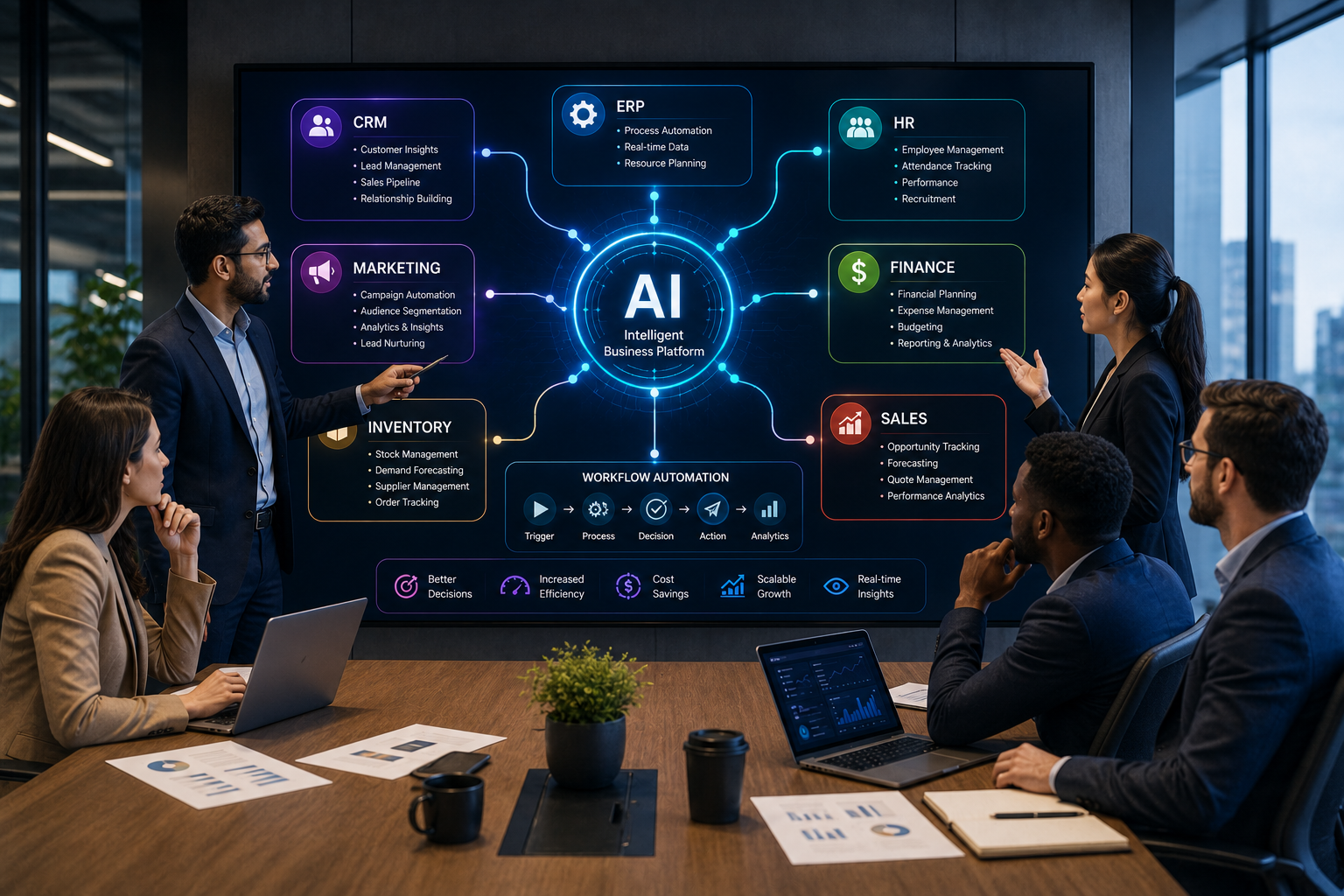
From intelligent search and AI-powered assistants to personalized recommendations and workflow automation, AI is transforming websites into interactive business platforms that actively improve customer experiences while reducing manual work behind the scenes.
The good news is that you don’t need to rebuild your entire website to benefit from AI.
Many of today’s most valuable AI features can be integrated into existing business websites or included as part of a new web application.
In this guide, we’ll explore twelve practical AI features that businesses should consider in 2026, how they work, and the value they can deliver.
Why AI Features Matter More Than Ever
Business websites are no longer judged only by their design.
- Visitors expect speed.
- Convenience.
- Personalization.
- Immediate answers.
If a website makes users wait, search endlessly for information, or complete unnecessary forms, they’ll often leave before becoming customers.
AI helps remove these friction points.
Instead of forcing visitors to adapt to the website, AI enables the website to adapt to the visitor.
For businesses, this means:
- Better customer experiences
- Higher conversion rates
- Reduced support workload
- Faster response times
- Smarter business insights
- More efficient internal processes
According to McKinsey, organizations continue increasing investment in AI because of its ability to improve operational efficiency, customer service, and decision-making across business functions.
Businesses looking to future-proof their digital platforms should view AI as an enhancement to existing technology rather than a replacement for it.
If you’re planning to build or modernize a digital platform, BwLogics AI Web Development Services focus on integrating practical AI capabilities into custom business applications.
1. AI Chat Assistants That Actually Help Customers
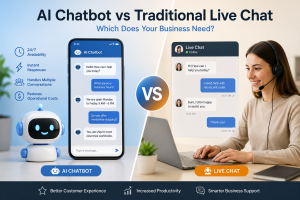
Traditional contact forms have one major problem. They make customers wait. Someone submits an enquiry. The message sits in an inbox. A team member responds hours; or sometimes days later.
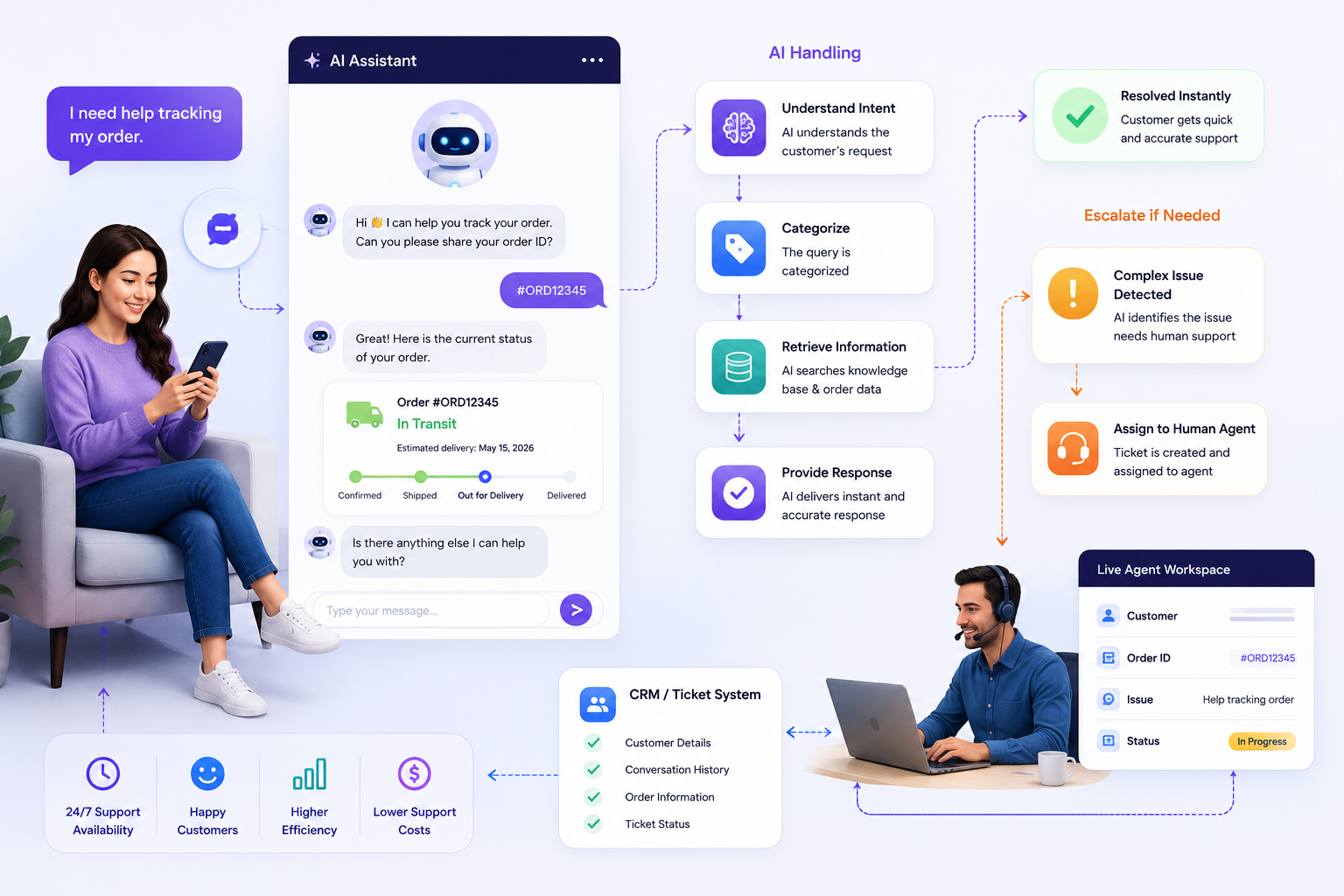
Modern AI assistants dramatically improve this experience. Instead of asking visitors to fill out forms, AI assistants can:
- Answer common questions instantly
- Recommend services
- Guide users through the website
- Capture lead information
- Schedule meetings
- Route complex enquiries to the right department
This creates a faster experience for customers while reducing the number of repetitive enquiries handled by support teams. The most effective AI assistants don’t replace human interaction, they handle routine conversations so employees can focus on more valuable work. Businesses implementing conversational AI often see improvements in customer engagement while reducing support response times.
2. Intelligent Site Search
Most website search bars still rely on exact keyword matching.
Unfortunately, people rarely search using the exact words businesses expect.
For example, a visitor might search:
“I need software for managing projects.”
A traditional search may return nothing useful.
An AI-powered search engine understands the user’s intent. Instead of looking only for matching keywords, it recognizes meaning, context, and related concepts before returning relevant content.
For businesses with large knowledge bases, ecommerce stores, or resource centres, intelligent search can significantly improve user experience. Microsoft’s AI search technologies demonstrate how natural language processing is changing the way users interact with digital platforms.
3. Personalized User Experiences
Every visitor arrives on your website with different goals.
A returning customer shouldn’t receive the same experience as someone visiting for the first time.
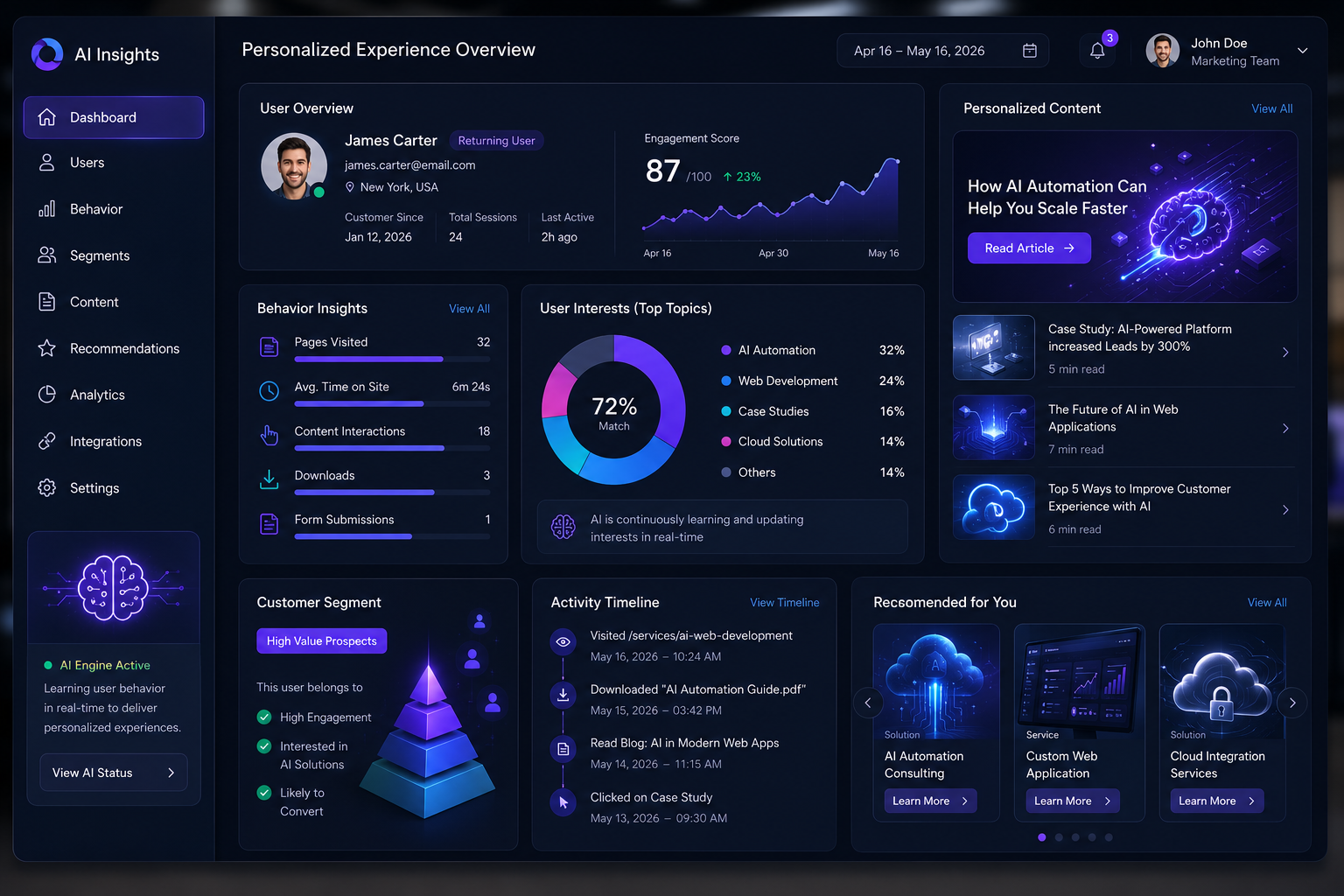
AI enables websites to personalize content based on factors such as:
- Previous visits
- Browsing behaviour
- Purchase history
- Geographic location
- Device type
- Interests
- Referral source
For example:
- An ecommerce website might recommend complementary products.
- A software company could highlight relevant case studies based on the visitor’s industry.
- A healthcare platform might recommend services based on previous appointments.
Instead of offering a one-size-fits-all experience, AI helps businesses deliver relevant information at the right time. This improves engagement while increasing the likelihood of conversion.
Learn more about creating intelligent customer experiences through Web Application Development.
4. Smart Lead Qualification
Not every website enquiry represents the same business opportunity. Some visitors are simply researching. Others are ready to purchase.
Traditionally, sales teams spend valuable time manually reviewing enquiries before deciding who to contact first. AI can automate this process.
By analyzing user behaviour, submitted information, company size, browsing activity, and engagement patterns, AI can automatically prioritize leads based on their likelihood of converting.
For example, AI can identify visitors who:
- Download multiple resources
- Visit pricing pages repeatedly
- Spend significant time reviewing services
- Request product demonstrations
- Return multiple times within a short period
Rather than treating every enquiry equally, sales teams can focus their attention on the highest-value opportunities first.
This not only improves efficiency but also shortens response times for prospects who are most likely to become customers.
5. AI Appointment & Booking Assistants
Booking meetings shouldn’t require multiple emails and manual scheduling.
AI-powered booking assistants can:
- Check availability
- Suggest meeting times
- Answer scheduling questions
- Send confirmations
- Issue reminders
- Reschedule appointments automatically
For businesses that rely on consultations, demos, or client meetings, this creates a smoother experience while reducing administrative work.
Rather than acting as a separate tool, these assistants can be integrated directly into your website, creating a seamless journey from enquiry to confirmed appointment.
6. Predictive Product & Service Recommendations
Have you ever noticed how platforms like Amazon or Netflix seem to know exactly what you’re looking for before you do?
That’s the power of AI-powered recommendation engines.
Instead of displaying the same content to every visitor, AI analyses behaviour, interests, previous interactions, and browsing history to suggest products, services, articles, or resources that are most relevant to each user.
For businesses, this means visitors spend less time searching and more time engaging with content that matches their needs.
Examples include:
- An ecommerce website recommending complementary products.
- A software company suggesting relevant case studies based on industry.
- A consultancy highlighting services aligned with the visitor’s interests.
- A learning platform recommending the next course or resource.
These personalized recommendations improve user experience while increasing conversions, average order value, and customer engagement.
Google Cloud highlights recommendation systems as one of the most practical AI applications for improving customer experiences across digital platforms.
7. AI Document Processing
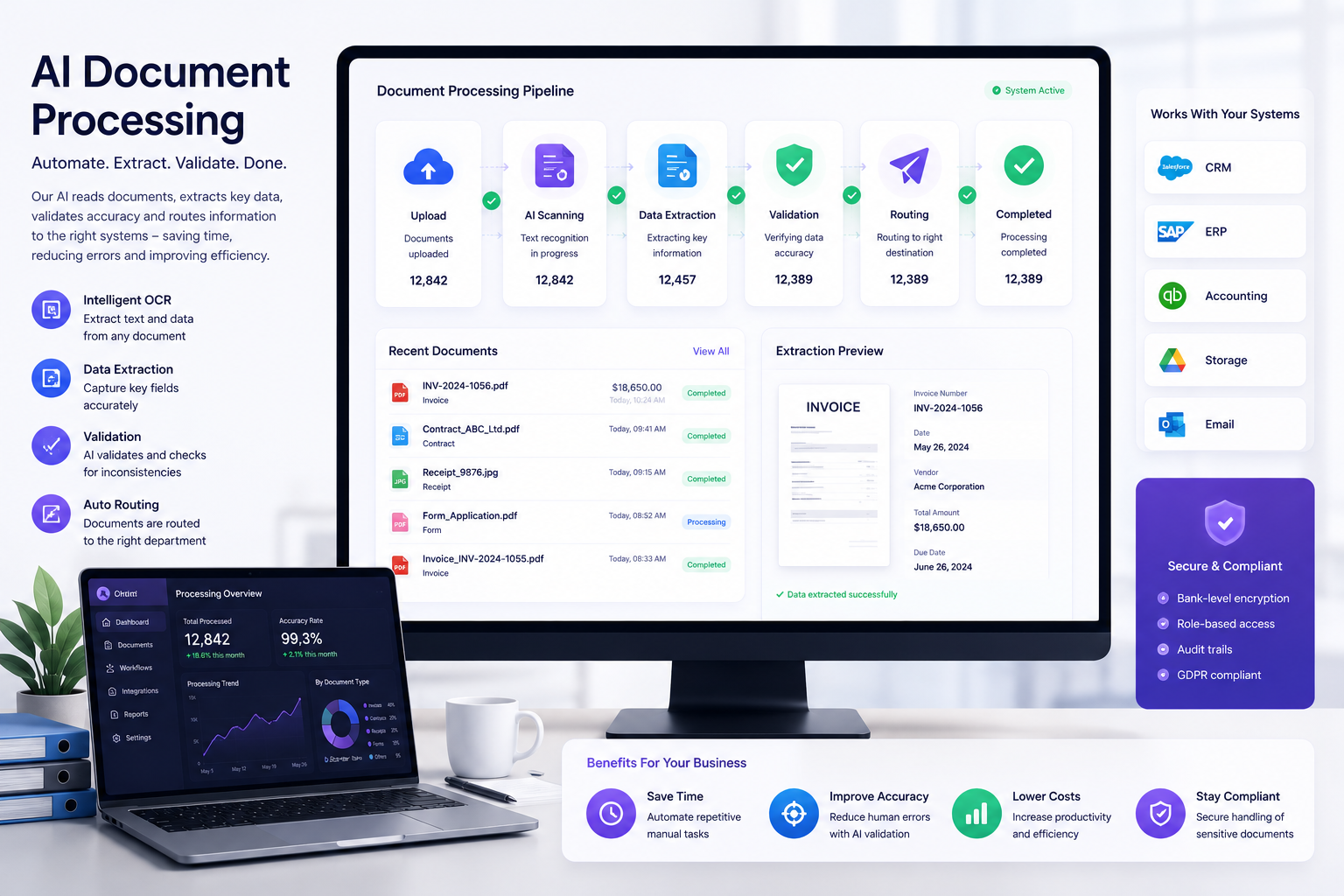
Many businesses still rely on employees to manually process invoices, contracts, application forms, receipts, and other business documents. This repetitive work consumes valuable time and increases the risk of human error. AI-powered document processing changes that completely.
Modern AI systems can automatically:
- Read uploaded documents
- Extract important information
- Validate data
- Categorise files
- Identify missing information
- Flag inconsistencies
- Route documents to the correct department
For industries such as finance, healthcare, insurance, logistics, and legal services, this significantly reduces administrative workloads while improving accuracy.
Instead of manually reviewing hundreds of documents, employees only need to verify exceptions that require human judgement.
8. Workflow Automation Across Your Business
One of the biggest advantages of AI isn’t what customers see. It’s what happens behind the scenes. Every website action can trigger an intelligent workflow.
Imagine someone submitting a contact form.
Instead of simply sending an email notification, AI can automatically:
- Qualify the lead.
- Create a CRM record.
- Notify the appropriate sales representative.
- Schedule a follow-up task.
- Send personalized confirmation emails.
- Recommend the most relevant service.
- Update reporting dashboards.
The result is a connected business process rather than isolated manual tasks.
As businesses grow, these automated workflows become increasingly valuable because they eliminate repetitive work while ensuring information flows consistently across departments.
If your organization relies on multiple systems working together, explore our Custom Software Development Services to create tailored integrations that fit your workflows.
9. AI Analytics That Explain What to Do Next
Traditional analytics platforms tell you what happened. AI analytics help explain why it happened and what to do next. Instead of spending hours analyzing reports, business leaders receive practical recommendations based on real-time data.
For example, AI dashboards can identify:
- Marketing campaigns that need optimization.
- Customers at risk of leaving.
- Products likely to experience higher demand.
- Sales opportunities requiring immediate attention.
- Operational bottlenecks.
- Revenue trends.
- Customer behaviour patterns.
Rather than replacing human decision-making, AI gives teams better information to make faster, more confident decisions.
10. AI-Powered Security & Fraud Detection
As websites collect increasing amounts of customer information, security has become just as important as functionality. Traditional security systems rely on predefined rules. AI goes much further. By continuously monitoring user behaviour, AI can identify unusual activity that might indicate fraud or security threats.
Examples include:
- Suspicious login attempts.
- Unusual payment behaviour.
- Abnormal account activity.
- Unexpected traffic patterns.
- Multiple failed authentication attempts.
Instead of waiting for a breach to occur, AI helps businesses respond proactively. For organizations handling sensitive customer information, this additional layer of intelligence can significantly improve security.
The National Institute of Standards and Technology (NIST) provides comprehensive guidance on implementing trustworthy AI systems.
11. AI Content Recommendations
Content plays an important role in educating customers but only if they can find it. AI recommendation engines help visitors discover relevant blogs, resources, case studies, videos, or services based on their interests.
For example, after reading an article about AI automation, a visitor might automatically see:
- How AI Is Transforming Modern Web Applications
- Custom Software Development Services
- AI Web Development
- Relevant case studies
- Industry-specific resources
This improves engagement while strengthening your website’s internal linking structure.
From an SEO perspective, it also encourages users to explore more pages, increasing session duration and reducing bounce rates.
12. Multilingual AI Assistance
Businesses increasingly serve customers across different countries and languages. AI-powered language tools make it easier to provide consistent support without maintaining separate teams for every language.
Modern AI assistants can:
- Translate conversations.
- Detect visitor language automatically.
- Provide multilingual customer support.
- Translate knowledge base articles.
- Adapt website experiences for international audiences.
Rather than creating completely separate customer journeys, businesses can offer personalized experiences regardless of language.
Which AI Features Should You Prioritize?
Not every business needs every AI capability from day one. The best approach is to identify where customers or employees experience the greatest friction.
Ask questions such as:
- Are customers waiting too long for answers?
- Does your team spend hours processing repetitive tasks?
- Are leads being followed up consistently?
- Is valuable business data underutilized?
- Are multiple systems disconnected?
Once these opportunities are identified, AI can be introduced strategically to deliver measurable improvements rather than unnecessary complexity.
Common Mistakes Businesses Make
As AI becomes more accessible, businesses often rush into implementation without a clear objective.
Some of the most common mistakes include:
- Adding AI simply because competitors are doing it.
- Choosing tools that don’t integrate with existing systems.
- Ignoring user experience in favour of flashy features.
- Expecting AI to replace every manual process.
- Failing to define measurable business outcomes.
Successful AI adoption begins with solving real business problems, not chasing technology trends.
Final Thoughts
Artificial Intelligence is no longer a futuristic concept reserved for large technology companies. It’s becoming a practical business tool that helps organizations improve customer experiences, automate repetitive tasks, and make better decisions.
The most successful businesses won’t necessarily be those using the most AI. They’ll be the ones using AI in the right places. Whether you’re modernizing an existing website or building a completely new digital platform, intelligent features can help your business become more efficient, responsive, and scalable.
At BwLogics, we design AI-powered websites and web applications that combine modern software engineering with practical business outcomes. Rather than adding AI for the sake of it, we focus on building solutions that solve real operational challenges and create measurable value.
If you’re exploring how AI can improve your digital platform, our team is ready to help.
Explore Our AI Web Development Services
Frequently Asked Questions
Can AI be added to an existing website?
Yes. Many AI features, including chat assistants, intelligent search, personalized recommendations, analytics, and workflow automation, can be integrated into existing websites without rebuilding everything from scratch.
Which AI feature delivers the fastest business value?
For many businesses, AI chat assistants, intelligent search, and workflow automation provide the quickest improvements by reducing manual work and improving customer experiences.
Are AI-powered websites only suitable for large companies?
No. Businesses of all sizes can benefit from AI. The key is implementing features that address specific business challenges rather than adding unnecessary complexity.
Does AI replace human employees?
No. AI is most effective when it supports employees by automating repetitive tasks, providing recommendations, and improving efficiency while leaving strategic decision-making to people.
How do I know which AI features my business needs?
The best starting point is identifying repetitive processes, customer pain points, and operational bottlenecks. From there, AI can be introduced where it creates measurable value.