If someone asked you five years ago what a web application could do, your answer would probably sound very different from today.
A customer logs in.
They complete a form.
The system stores information.
Someone manually reviews it.
The customer waits for a response.
For years, that’s how most business applications worked.
Today, expectations have changed.
Customers expect applications to understand what they’re trying to achieve, recommend the next step, answer questions instantly, personalise their experience, and even complete repetitive tasks automatically.
This isn’t because websites have become more advanced.
It’s because Artificial Intelligence is changing how modern web applications are built.
AI isn’t replacing websites.
It’s making them smarter.
Businesses are no longer asking whether they need digital platforms—they’re asking how those platforms can become intelligent enough to improve customer experiences, reduce manual work, and support business growth.
Whether you’re building an internal business system, a customer portal, a SaaS platform, or an ecommerce solution, AI has become one of the biggest opportunities to create software that delivers more value for both users and businesses.
In this guide, we’ll explore how AI is transforming modern web applications, where it delivers the biggest business impact, and how organizations can begin adopting AI without rebuilding everything from scratch.
What Is AI Web Development?
AI web development is the process of integrating artificial intelligence into websites and web applications to make them more intelligent, efficient, and responsive.
Instead of following only predefined rules, AI-powered applications can analyse data, recognise patterns, automate decisions, personalise user experiences, and continuously improve based on interactions.
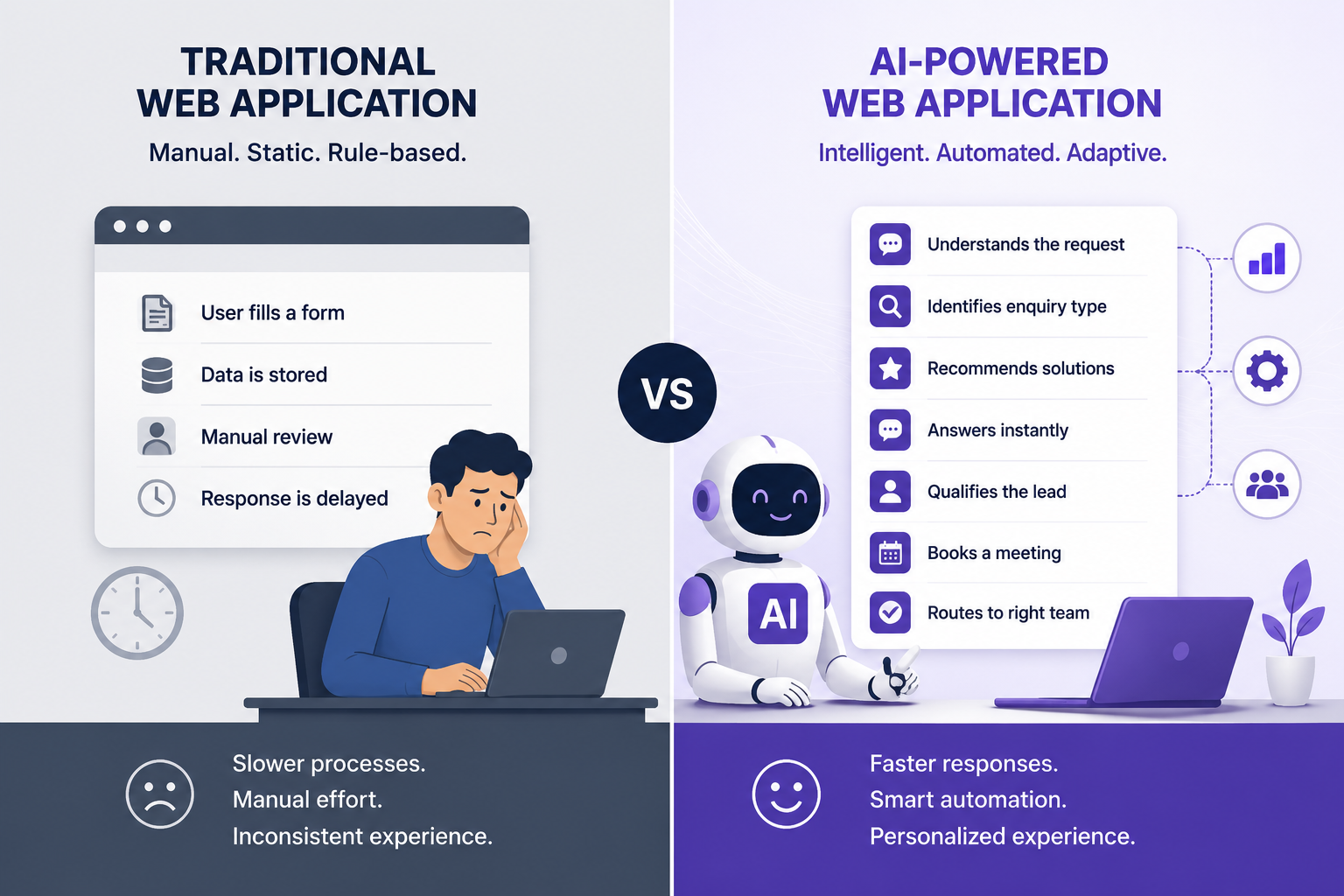
Think about the difference between these two customer experiences.
Traditional Web Application
A customer submits an enquiry.
The system stores it.
An employee reviews it.
The employee replies later.
AI-Powered Web Application
A customer submits an enquiry.
AI identifies the enquiry type.
It recommends relevant services.
Answers common questions instantly.
Qualifies the lead.
Books a meeting.
Routes complex enquiries to the correct department.
The customer receives help immediately.
That’s the difference AI creates.
It removes unnecessary manual work while creating faster, more personalized experiences.
Businesses looking to build intelligent digital platforms often start with a strong technical foundation. Our AI Web Development Services help organizations design applications that combine modern software engineering with practical AI capabilities.
Why Businesses Are Investing in AI Web Applications
Every growing business eventually reaches the same challenge.
More customers.
More employees.
More data.
More processes.
But not necessarily more time.
As organizations grow, manual workflows become increasingly difficult to manage. Support teams answer repetitive questions.
Sales teams manually qualify leads.
Operations teams update spreadsheets.
Managers spend hours preparing reports.
Marketing teams analyze multiple platforms separately.
AI helps businesses reduce this operational friction.
According to McKinsey’s State of AI report, organisations continue expanding AI adoption across customer service, operations, marketing, software development, and product management to improve productivity and business performance.
Similarly, IBM’s Global AI Adoption Index found that improving operational efficiency remains one of the primary reasons businesses invest in AI technologies.
The message is clear.
Businesses aren’t investing in AI because it’s fashionable.
They’re investing because manual processes don’t scale.
Traditional Web Applications vs AI-Powered Web Applications
| Traditional Web Applications | AI-Powered Web Applications |
| Static workflows | Intelligent workflows |
| Same experience for every user | Personalized experiences |
| Manual decision-making | AI-assisted recommendations |
| Fixed search functionality | Natural language search |
| Manual customer support | AI-powered assistance |
| Static dashboards | Predictive insights |
| Rule-based automation | Adaptive automation |
Notice something?
Most improvements aren’t visual.
They’re operational.
AI doesn’t necessarily change how an application looks.
It changes how intelligently it behaves.
1. Smarter Customer Experiences
One of the most noticeable changes AI brings to web applications is personalization.
Instead of showing identical content to every visitor, AI can adapt experiences based on user behaviour, previous interactions, location, preferences, and browsing history.
Think about how Netflix recommends shows.
Or how Amazon suggests products.
Modern business applications can do exactly the same.
For example:
A healthcare platform might recommend relevant services based on previous appointments.
A real estate platform might prioritize properties matching a user’s interests.
An ecommerce website could display personalized offers based on purchasing behaviour.
This improves customer satisfaction while increasing engagement and conversion rates.
Businesses that combine AI with custom web applications often create experiences that simply aren’t possible using generic software alone.
Learn more about our Web Application Development Services.
2. AI-Powered Search
Traditional search functions rely on exact keywords.
If users search differently, they often fail to find what they’re looking for.
AI changes this completely.
Instead of matching keywords, AI understands intent.
For example:
Traditional Search
“invoice”
Results:
Files containing the exact word “invoice.”
AI Search:
“Show invoices from last month that haven’t been paid.”
The application understands the request.
Finds the correct documents.
Applies filters automatically.
Returns meaningful results. This dramatically improves usability, particularly for businesses managing thousands of records. Microsoft describes this evolution as moving from keyword matching towards intelligent document understanding and natural language interaction.
3. Intelligent Business Automation
One of the biggest misconceptions about AI is that it’s only useful for chatbots.
In reality, some of the highest ROI comes from automating internal workflows.
For example:
Instead of an employee manually reviewing every customer enquiry:
AI can:
- Categorise requests
- Prioritise urgency
- Assign departments
- Generate responses
- Notify managers
- Track completion
The employee reviews only the exceptions. Everything else happens automatically.
This doesn’t replace people.
It removes repetitive work.
Many organizations begin this journey by identifying repetitive workflows before introducing AI. If you’re exploring practical examples, read our guide on 10 Business Processes You Should Automate Using AI, which explains where automation delivers the fastest business impact.
4. Predictive Analytics & Smarter Decision-Making
Most business applications do a great job of showing what has already happened.
- Sales reports tell you last month’s revenue.
- CRM dashboards show closed opportunities.
- Analytics platforms display yesterday’s traffic.
While this information is useful, it doesn’t always help businesses decide what to do next.
This is where AI creates a significant advantage.
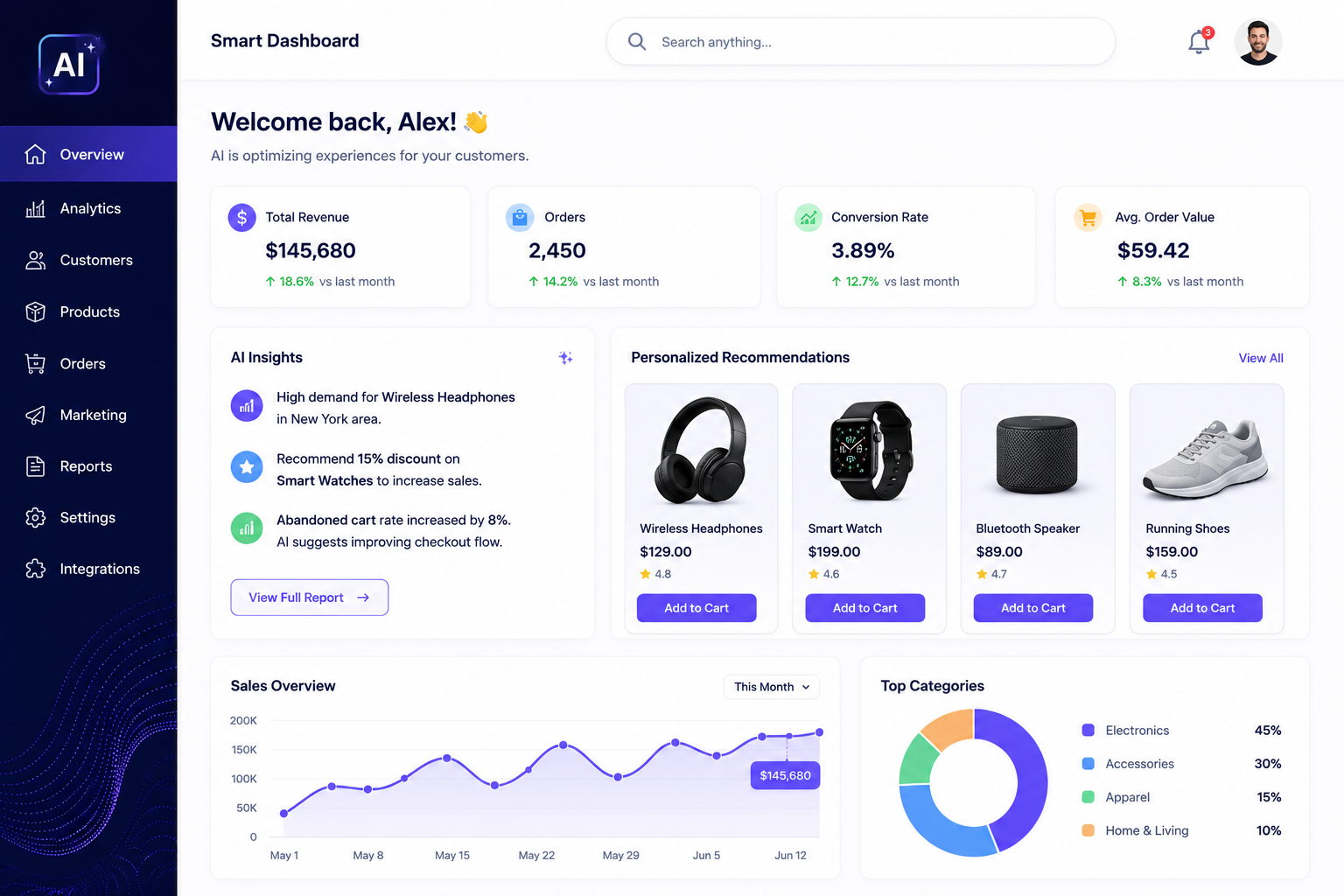
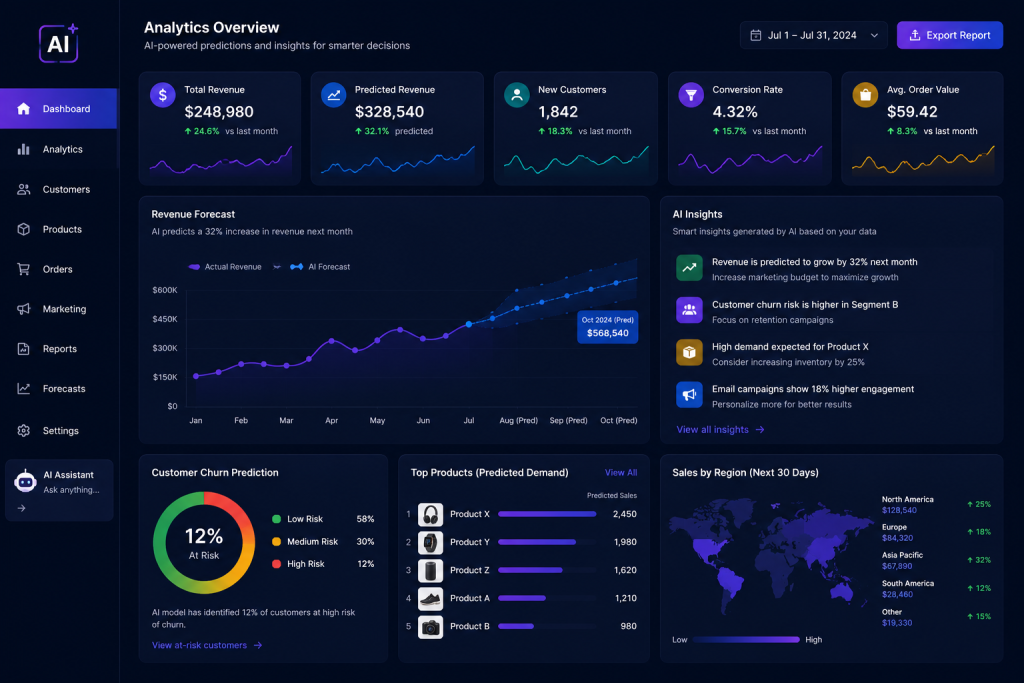
Modern AI-powered web applications don’t just report data, they analyze it, identify patterns, and generate recommendations based on historical behaviour and real-time information. For example, an AI-powered ecommerce dashboard can identify products that are likely to run out of stock, predict seasonal demand, and recommend reorder quantities before shortages occur.
A sales platform can identify which leads are most likely to convert, helping teams prioritize their efforts. A project management system can predict delivery delays by analyzing previous project performance and current workloads.
Instead of reacting to problems after they occur, businesses can make proactive decisions.
Business Applications of Predictive Analytics
- Sales forecasting
- Customer churn prediction
- Inventory planning
- Demand forecasting
- Financial forecasting
- Resource allocation
- Project risk analysis
- Marketing campaign optimization
Google Cloud highlights predictive AI as one of the most valuable ways organizations can improve operational efficiency by making data-driven decisions rather than relying solely on historical reporting.
5. AI Chatbots Have Become Business Assistants
When many people hear the word “chatbot,” they still imagine frustrating automated replies that rarely answer the right question.
Modern AI assistants are completely different. Instead of following rigid scripts, today’s AI assistants understand natural language, remember context, and interact with users much more naturally.
More importantly, they don’t just answer questions.
They complete tasks.
For example, an AI assistant can:
- Book appointments
- Generate quotations
- Retrieve customer information
- Update CRM records
- Recommend products
- Collect support requests
- Escalate complex enquiries
- Schedule meetings
This transforms the chatbot from a customer service tool into a business productivity tool.
Practical Example
Imagine a property management company receiving enquiries 24 hours a day.
Instead of asking visitors to complete a lengthy contact form, an AI assistant asks a few simple questions, recommends relevant properties, schedules viewings, and notifies the sales team—all before a human becomes involved.
The customer receives a faster experience while the business captures more qualified leads.
If you’re considering conversational AI for your business, integrating it into a custom platform often delivers significantly more value than relying on standalone chatbot software. Explore BwLogics’ AI Web Development Services to see how intelligent assistants can become part of your customer experience.
6. Stronger Security & Fraud Detection
Security has become one of the biggest concerns for modern web applications.
As businesses collect more customer information and process more online transactions, identifying suspicious behaviour becomes increasingly important.
Traditional security systems rely on predefined rules.
AI goes further.
It continuously monitors user behaviour, detects unusual activity, identifies anomalies, and flags potential threats before they become major security incidents.
Examples include:
- Unusual login locations
- Suspicious payment behaviour
- Multiple failed login attempts
- Unexpected account activity
- Abnormal transaction values
Rather than waiting for a security breach, AI helps businesses respond much earlier.
The National Institute of Standards and Technology (NIST) also emphasises the importance of responsible AI implementation and risk management when integrating AI into business systems.
AI Features Every Modern Business Application Should Consider
Not every application needs every AI feature.
The right solution depends on your business goals.
However, these are some of the most valuable AI capabilities organizations are implementing today.
| AI Feature | Business Benefit |
|---|---|
| Intelligent Search | Faster information retrieval |
| AI Chat Assistant | Improved customer support |
| Recommendation Engine | Higher conversions |
| Predictive Analytics | Better business decisions |
| Document Processing | Reduced manual work |
| Workflow Automation | Improved operational efficiency |
| Lead Qualification | Higher sales productivity |
| Smart Reporting | Real-time business insights |
| Personalization | Better customer experience |
| Fraud Detection | Improved security |
The objective isn’t to add AI everywhere.
It’s to identify where intelligence creates measurable business value.
Common AI Web Development Mistakes
As AI becomes more accessible, many businesses rush into implementation without a clear strategy.
Here are some of the most common mistakes we see.
Building Features Instead of Solving Problems
Adding AI simply because competitors are doing it rarely delivers meaningful results.
Instead, identify the biggest operational bottlenecks first.
Then determine whether AI is the right solution.
Ignoring Existing Systems
Many businesses already have CRM, ERP, accounting, or inventory platforms. The goal shouldn’t be replacing everything. It should be connecting existing systems through intelligent automation.
Choosing Generic AI Tools
Off-the-shelf AI platforms work well for common tasks.
However, businesses with unique workflows often benefit from custom AI solutions designed specifically around their operations.
That’s where custom web applications become valuable.
Learn how BwLogics develops scalable Custom Software Development solutions tailored to business needs.
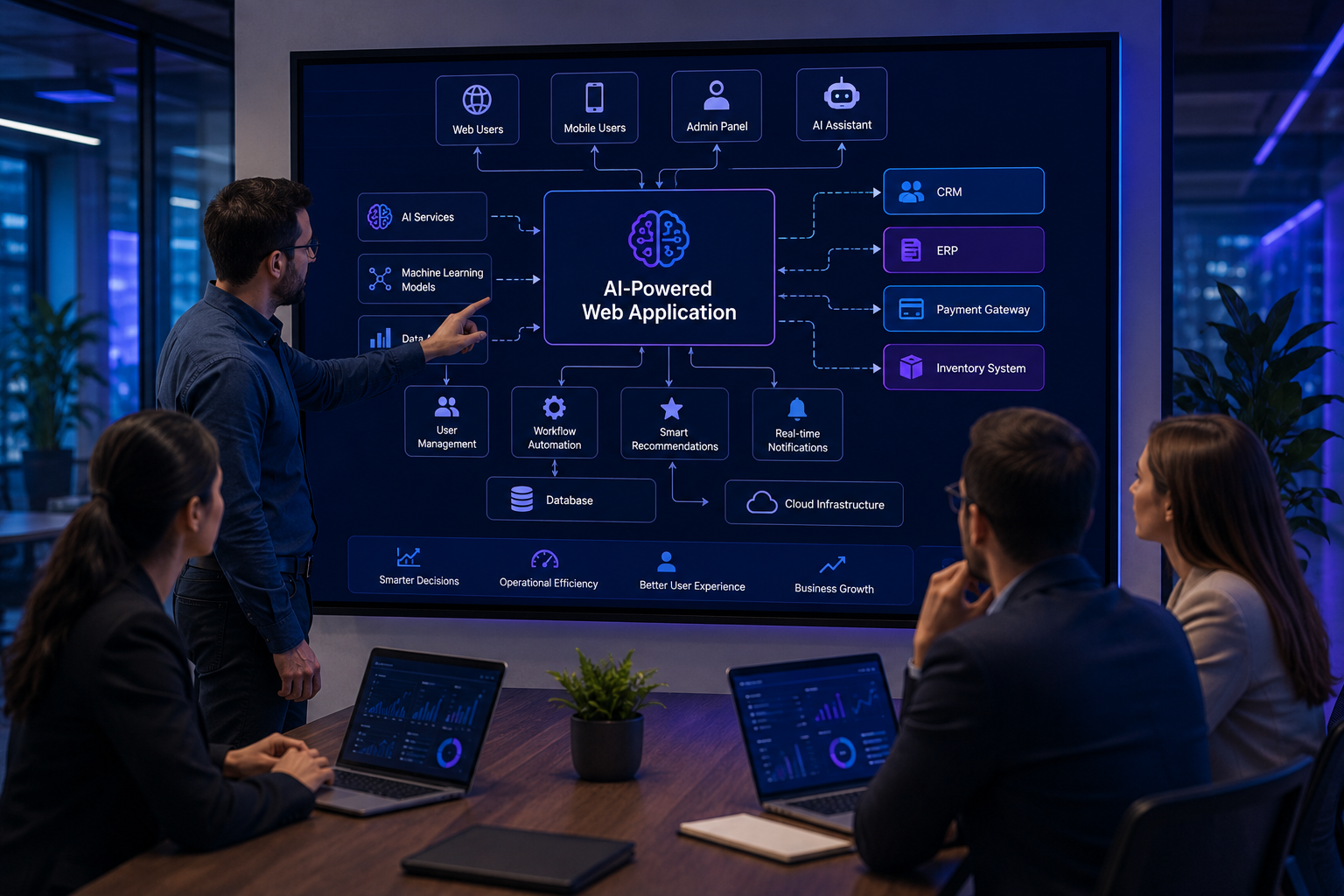
Is Your Business Ready for AI Web Development?
If your business experiences any of the following, AI may already be delivering value to your competitors.
- Your team spends hours on repetitive administrative work.
- Customers regularly ask the same questions.
- Multiple systems don’t communicate effectively.
- Reporting takes too long.
- Data is manually entered into several platforms.
- Employees switch between numerous software tools.
- Customer response times continue increasing.
- Growth is creating operational bottlenecks.
If several of these challenges sound familiar, it may be time to evaluate how AI can improve your existing digital platforms.
Final Thoughts
Artificial Intelligence is changing web applications in much the same way mobile technology changed websites a decade ago.
It’s no longer just about creating digital experiences.
It’s about creating intelligent digital experiences.
Businesses that successfully adopt AI aren’t replacing people or rebuilding everything from scratch. They’re identifying repetitive tasks, improving customer experiences, connecting existing systems, and using AI where it delivers measurable value.
Whether you’re building a customer portal, internal business platform, ecommerce solution, SaaS application, or enterprise dashboard, AI can help your software become more efficient, more responsive, and more valuable.
At BwLogics, we design and develop AI-powered web applications that solve real business challenges, not just impressive technical demonstrations.
If you’re exploring AI for your next digital project, our team can help you identify the opportunities that deliver the greatest business impact.
👉 Talk to our AI Web Development experts
Frequently Asked Questions
What is AI web development?
AI web development involves integrating artificial intelligence into websites and web applications to automate workflows, personalize experiences, analyze data, and improve business operations.
Can AI be added to an existing web application?
Yes. Many AI capabilities including chatbots, predictive analytics, document processing, and workflow automation can be integrated into existing applications without rebuilding the entire platform.
Is AI web development only for large businesses?
No. Businesses of all sizes can benefit from AI, especially when automating repetitive tasks or improving customer experiences.
What’s the difference between AI web development and traditional web development?
Traditional web development focuses on predefined functionality, while AI web development introduces intelligent features that learn, adapt, and assist users.
Which industries benefit most from AI web applications?
Healthcare, ecommerce, logistics, manufacturing, construction, finance, education, and professional services are all seeing significant benefits from AI-powered applications.